
Beyond the Bike Seat: The Real Rules for Trailers and Cargo Bikes With Toddlers
A rear or front-mounted bicycle child seat is the most familiar option for carrying a small child in Munich, and it's covered by its own dedicated rules, ages roughly 1 to 7, DIN EN 14344 certification, a 16-plus rider, that this page won't repeat. Once your family outgrows a single seat, or wants to carry more than one child, two genuinely different vehicles take over, and they're governed by separate parts of § 21 StVO. A bike trailer (Fahrradanhänger) built for children can legally carry up to two children under the completed age of 7, each strapped in and each under 22 kilograms, with a combined trailer weight limit of 60 kilograms, and it must meet the DIN EN 15918 safety standard. A cargo bike (Lastenrad) built and equipped specifically for passenger transport works completely differently: since Germany's 2020 StVO reform, there's no age limit at all on the children it carries, only the requirement that the rider be at least 16. Munich itself once ran a municipal cargo bike purchase subsidy, but the city council ended that program as of July 2, 2025, so budget for the full purchase price or ask an employer about Dienstrad-Leasing (a salary-conversion bike lease) instead.
The Official Rule
If your family has already read up on bicycle child seats, DIN EN 14344, roughly ages 1 to 7, a 16-plus rider, this page picks up exactly where that one leaves off. A trailer and a cargo bike are both real, legal alternatives once a single mounted seat stops being the right tool, and each comes with its own distinct rule set under § 21 StVO, Germany’s federal road traffic regulation.
A child bike trailer (Fahrradanhänger) has a specific, two-part legal limit. Behind a bicycle, a trailer genuinely built for children can carry up to two children who haven’t yet turned 7, each accompanied by a rider who is at least 16. That’s the age side of the rule. The weight side comes from the DIN EN 15918 safety standard: each child must weigh no more than 22 kilograms, and the trailer’s total permitted weight, including any cargo alongside the children, tops out at 60 kilograms. A certified trailer needs a closed passenger compartment with genuine protection against feet reaching the wheel spokes, and a secure harness, ideally a padded 5-point belt anchored directly to the frame rather than just the seat fabric.
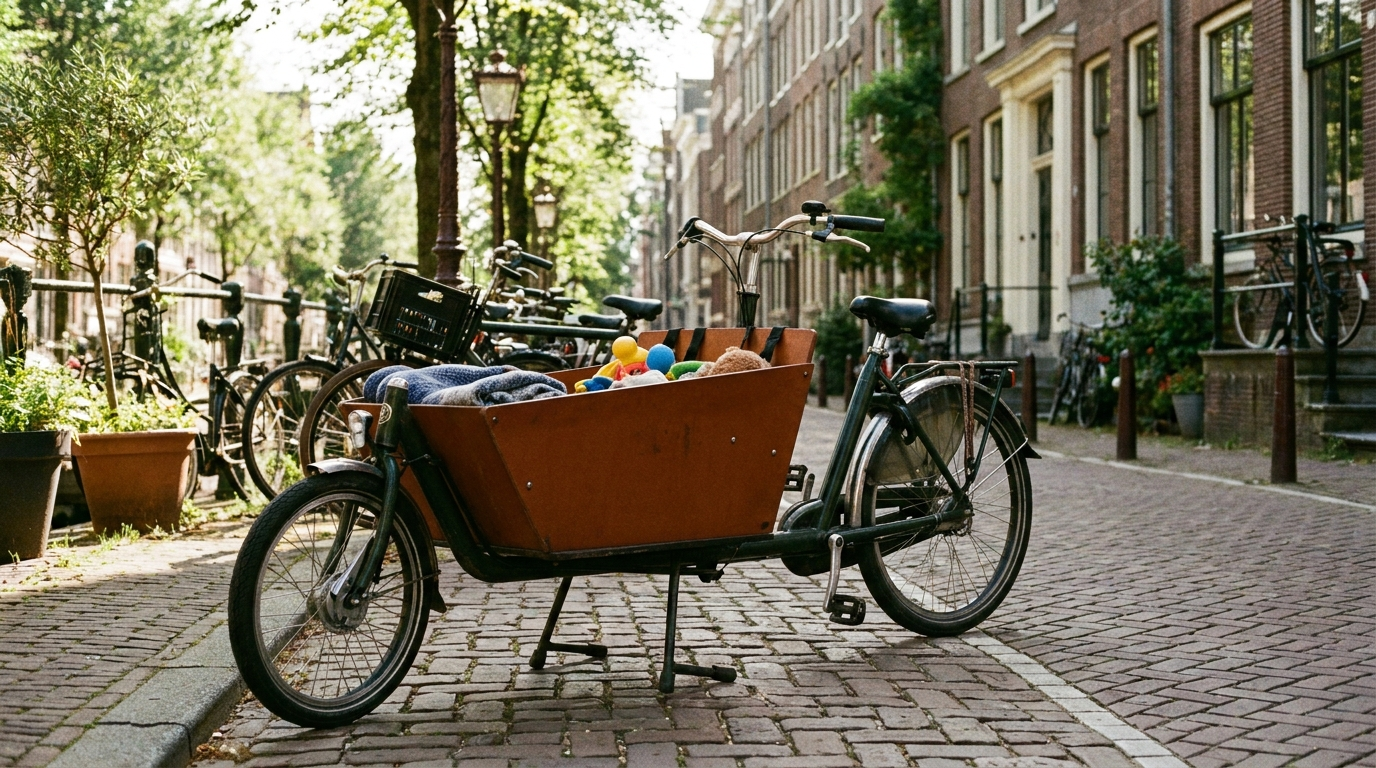
A cargo bike (Lastenrad) built and equipped specifically for passenger transport plays by a completely different rule. Germany’s StVO reform of April 2020 added language to § 21 Abs. 3 specifically covering bicycles constructed and equipped for carrying people, the clearest real-world examples being rickshaws and dedicated cargo bikes. The practical effect: there’s no upper age limit at all on the children (or, for that matter, adults) a genuine passenger-transport cargo bike can carry, only the requirement that the person riding it is at least 16. This is a real, relatively recent legal change, not a longstanding rule, before 2020 the same under-7 cap that applies to trailers effectively applied here too.
| Option | Legal basis | Age limit | Weight limit |
|---|---|---|---|
| Bicycle child seat (Kindersitz) | § 21 StVO, DIN EN 14344 | Roughly 1-7 years | ~15kg front, ~22-25kg rear |
| Bike trailer (Fahrradanhänger) | § 21 StVO, DIN EN 15918 | Under 7 (no cap for disabled children) | 22kg per child, 60kg trailer total |
| Cargo bike (Lastenrad), purpose-built for passengers | § 21 StVO, 2020 reform | No age limit | Model-dependent, up to ~200kg cargo |
Munich no longer subsidizes the purchase itself. The city ran a cargo bike purchase subsidy as part of its broader “Klimaneutrale Antriebe” climate-mobility funding program, but the city council formally ended it as of July 2, 2025, and no new applications are being accepted, a status independently corroborated by lastenrad-zentrale.de. A federal BAFA subsidy covering up to 25% of the purchase price, capped at 3,500 euros, still runs through June 2027, but it’s restricted to commercial and self-employed buyers, not private families. If your employer offers Dienstrad-Leasing, a bike obtained through salary conversion, this can meaningfully lower the effective cost of a cargo bike compared to buying one outright, worth asking about before ruling a cargo bike out on price alone.
What Real People Say
Comparison guides aimed at real families, like e-lastenrad.de’s trailer-versus-cargo-bike breakdown, consistently frame this as a genuine tradeoff rather than one option being simply better. A trailer sits lower, which makes it harder to tip in a fall, and its enclosed, curtained design means a small child can lean their head back and actually fall asleep on a longer ride, something families report as a real practical advantage on errands that run past nap time. A cargo bike puts children directly in front of the rider, within easy conversation and eye contact the whole ride, and it scales much further: some models carry up to four children or a genuinely useful mix of children and groceries, with no age ceiling to plan around as your family grows. The tradeoff that comes up repeatedly: a trailer folds down and travels in a car boot, a cargo bike generally doesn’t, so families who need to combine biking with occasional car trips often lean toward the trailer specifically for that portability.
Step by Step
- Confirm which vehicle you actually need before shopping, if you’re still within the seat’s age and weight range, you may not need a trailer or cargo bike at all yet.
- For a trailer, check the DIN EN 15918 certification and each child’s actual weight, not just their age, the 22kg per-child and 60kg total limits are real constraints, not suggestions.
- For a cargo bike, confirm the specific model is built and equipped for passenger transport, not a general cargo model repurposed for children, since that’s what the 2020 age-limit exception actually depends on.
- Whichever you choose, the rider must be at least 16, this applies identically to both a trailer and a passenger-equipped cargo bike.
- Don’t count on a Munich city subsidy for the purchase, the municipal program ended July 2, 2025, check instead whether your employer offers Dienstrad-Leasing.
- If you’ll sometimes need to combine biking with a car trip, weigh the trailer’s portability, it folds and fits in a boot in a way most cargo bikes don’t.
Compliance Note
This page explains the general German federal rules (§ 21 StVO) and safety standards (DIN EN 14344/15918) for transporting children by bicycle, current as of mid-2026, but manufacturer certifications, subsidy programs, and specific model specifications can change. Confirm a specific trailer or cargo bike’s certification directly with the manufacturer before purchase.
FAQ & Common Pitfalls
Isn't this just the same as the bicycle child seat rules?
No, and this is the mix-up worth clearing up first. A bicycle child seat (Kindersitz), the kind mounted directly on the frame front or back, is covered by its own rule set, roughly ages 1 to 7, DIN EN 14344 certification, weight limits around 15kg front-mounted and 22-25kg rear-mounted. A trailer (Anhänger) towed behind the bike and a cargo bike (Lastenrad) built for passengers are both legally and practically different vehicles, governed by different clauses of § 21 StVO, with different age and weight rules of their own.
How many children can a trailer actually carry, and is there really a weight limit?
Up to two children under the completed age of 7, and yes, there's a real weight limit. Under the DIN EN 15918 safety standard, each child in a certified trailer must weigh no more than 22 kilograms, and the trailer's total permitted weight, children plus any cargo, is capped at 60 kilograms. The trailer itself needs a closed compartment with wheel-access protection and a secure harness, ideally a padded 5-point belt anchored to the frame.
Is it true cargo bikes have no age limit for kids at all?
Yes, and this is a genuinely recent change, not a long-standing rule. Germany's April 2020 StVO reform added a specific exception for bicycles built and equipped for passenger transport, cargo bikes and rickshaws being the clearest examples, removing the under-7 age cap that otherwise applies to bike passengers. The rider still has to be at least 16, and the bike itself has to be genuinely designed for carrying people, not a standard cargo bike improvised for the job.
Can I still get a subsidy in Munich for buying a cargo bike?
Not from the city itself anymore. Munich's municipal purchase subsidy program for cargo bikes, part of its broader climate-neutral mobility funding, was formally ended by the city council as of July 2, 2025, and no new applications are being accepted. A federal BAFA subsidy still exists but is limited to commercial and self-employed buyers, not private families. Ask your employer whether they offer Dienstrad-Leasing, a salary-conversion bike lease that can make a cargo bike noticeably cheaper than a straight purchase through its tax treatment.