
Your Mom Sent a Care Package From Home: What German Customs Actually Charges
A genuine gift package from family abroad, food, treats, small items, sent person-to-person with no payment involved, clears German customs free of duty and import VAT as long as the goods themselves are worth 45 euros or less. That 45-euro limit covers only the value of the goods, not the shipping cost, and it comes with tighter sub-limits on specific items: 50 cigarettes, 1 liter of spirits over 22% alcohol, 2 liters of wine, 500 grams of coffee. Go over 45 euros and the whole shipment gets a flat 17.5% customs charge on its total value, including postage this time, up to 700 euros, above that it's calculated item by item. The recipient, meaning you, pays whatever's owed when the carrier delivers, this isn't something you pre-pay. One separate but easily confused rule: as of July 1, 2026, the old duty-free allowance for ordinary e-commerce orders under 150 euros from outside the EU ended, with a flat 3-euro customs fee now applied per goods category, but that change is about online purchases, not genuine private gifts, the 45-euro gift exemption itself stayed exactly where it was.
The Official Rule
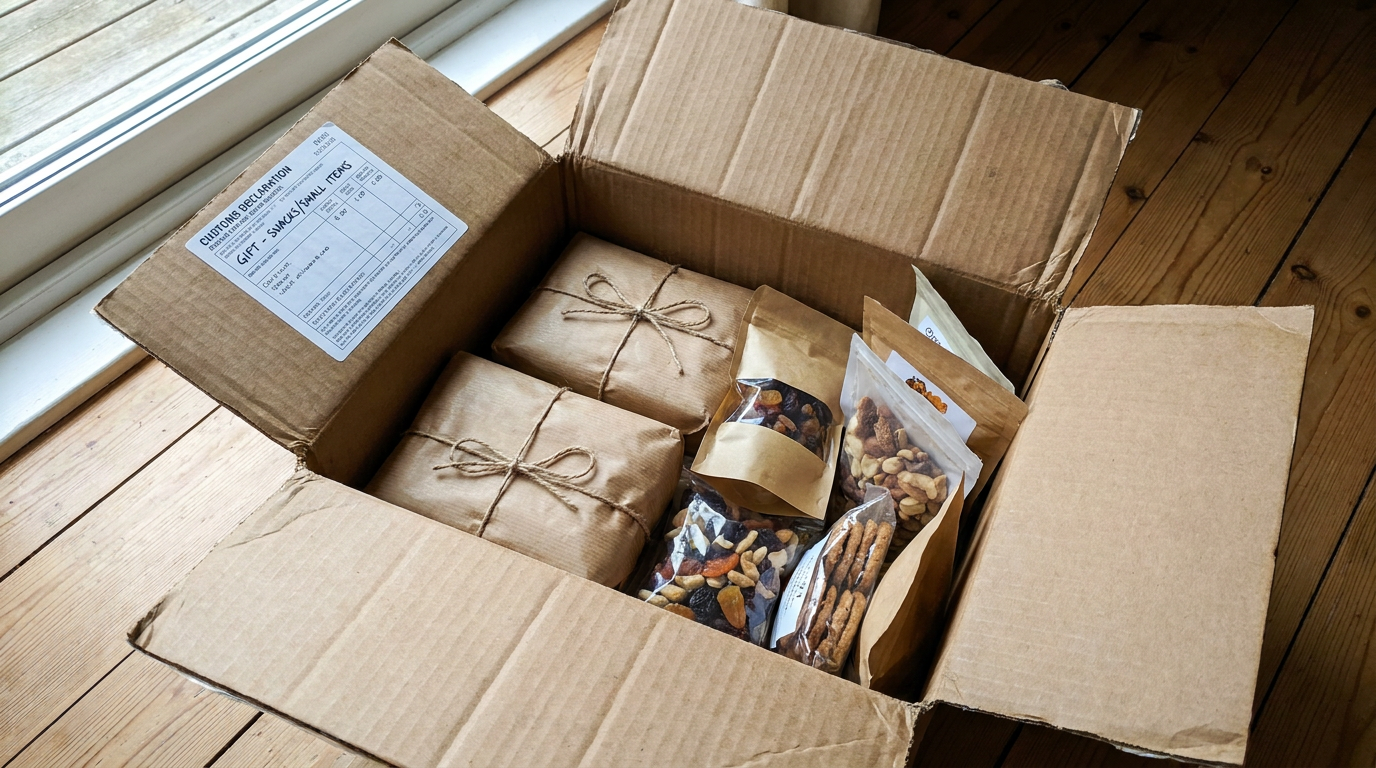
A package from family abroad, home-country snacks, small gifts, things you can’t easily find in Germany, can cross the border without any duty or import VAT, but only if it genuinely qualifies as a Geschenksendung, a gift shipment, under German customs rules. Qualifying isn’t just about value, it’s about the nature of the shipment itself: it has to be sent between private individuals, involve no commercial purpose, happen only occasionally rather than on a regular schedule, and the recipient can’t have paid the sender anything for it.
Assuming it qualifies as a genuine gift, the goods themselves are duty-free up to 45 euros in value. That 45-euro figure is specifically the Sachwert, what a seller in a non-EU country would charge an EU customer for those exact goods, and importantly, it does not include what was spent on shipping. A 40-euro box of goods with 15 euros of postage still clears under the 45-euro gift threshold.
| Item | Maximum quantity still duty-free |
|---|---|
| Tobacco | 50 cigarettes, or 10 cigars, or 50g rolling tobacco |
| Spirits (over 22% alcohol) | 1 liter |
| Wine | 2 liters |
| Perfume | 50g, or 0.25L eau de toilette |
| Coffee | 500g |
Go over the 45-euro goods value and the calculation changes meaningfully, not just for the amount over the limit, but for the whole shipment. Between 45 and 700 euros, a flat 17.5% customs charge applies to the shipment’s total value, and this time that total does include shipping cost. Above 700 euros, customs moves to an individual, item-by-item tariff calculation instead of the flat rate.
Whatever duty is owed gets collected from you, the recipient, at the point of delivery, this isn’t something prepaid by whoever sent the package. The courier collects it when the package actually arrives, so it’s worth being prepared for that rather than being caught off guard by an unexpected charge at the door.
A separate, recent change is worth knowing about specifically so you don’t confuse it with the gift rule above. As of July 1, 2026, the previous duty-free allowance for ordinary e-commerce orders under 150 euros bought from outside the EU ended, and a flat 3-euro customs fee per goods category in the shipment now applies instead. This is entirely about online purchases, not genuine gifts from family, the 45-euro Geschenksendung exemption and its conditions weren’t touched by this change at all.
What Real People Say
Families who regularly receive care packages from relatives abroad describe the practical rule of thumb as keeping individual shipments modest in value and genuinely spaced out, rather than trying to maximize what fits under the 45-euro line every time, since customs treatment hinges as much on the pattern of shipping as on any single package’s contents.
The distinction between the gift exemption and the newer e-commerce rule change comes up often enough in practical discussion that it’s worth stating plainly: online orders and family gift packages are governed by genuinely different rules, and news coverage of the 2026 e-commerce change has understandably confused some people into thinking their family’s care packages got more expensive too, when that specific allowance didn’t change.
Step by Step
- Confirm your package actually qualifies as a Geschenksendung: private sender, private recipient, no payment involved, sent only occasionally.
- Keep the goods’ value at 45 euros or under to stay duty-free, remembering this figure excludes shipping cost.
- Watch the sub-limits on tobacco, alcohol, perfume, and coffee even within an otherwise qualifying gift shipment.
- If a shipment does go over 45 euros, expect a flat 17.5% charge on the total value including postage, not just on the excess amount.
- Be prepared to pay at delivery, the carrier collects whatever customs duty is owed directly from you when the package arrives.
Compliance Note
This page explains the general German customs framework for private gift shipments from abroad, but exact classification, applicable rates, and enforcement can vary by shipment and change over time. For a specific package or ongoing pattern of shipments, confirm current rules directly with German customs (Zoll).
FAQ & Common Pitfalls
My parents send the same care package every couple of months. Does that still count as a duty-free gift?
This is exactly where it can get complicated. Customs defines a genuine Geschenksendung partly by frequency, it has to be occasional, not a regular pattern. A package every few months from the same sender to the same recipient is a genuinely gray area, occasional gift-giving between family is normal, but a rule-following interpretation matters here, so it's worth keeping shipments genuinely infrequent and not, say, monthly, to stay clearly within the gift definition rather than something that starts to look like recurring commercial shipping.
If my package is worth 60 euros in goods, do I only pay duty on the 15 euros over the limit?
No, and this catches people off guard. Once you're over the 45-euro threshold, the flat 17.5% customs charge applies to the entire shipment's value, not just the amount above the limit, and this time shipping cost is included in that calculation too. So a 60-euro shipment with 10 euros of postage gets charged 17.5% of the full 70 euros, not 17.5% of 15 euros.
Does the July 2026 rule change mean small gift packages from family now get charged more?
No, this is a common point of confusion worth clearing up directly. The change that took effect July 1, 2026, ended the duty-free allowance for ordinary e-commerce orders under 150 euros bought from outside the EU, introducing a flat 3-euro customs fee per goods category on those. It's a separate rule aimed at online shopping, and it doesn't touch the 45-euro genuine-gift exemption at all, that allowance and its conditions (private sender, private recipient, no payment, occasional) remain exactly as they were.