
Pfandring, Bottle Collectors, and Munich's 'Deposit Belongs Next to It' Movement
If you'd rather your empty deposit bottle go to someone who collects them for a living than get thrown out with the rest of your trash, there are two informal Munich-area practices worth knowing. The first is the Pfandring, a metal ring or crate attached to the outside of a public trash bin so bottles sit visibly on top rather than inside, letting collectors take them without digging through garbage; it was invented in Cologne in 2012 and used in roughly 110 German municipalities by 2021, but Munich itself has no official city program, the ones that exist, at spots like Theresienwiese, Hauptbahnhof, and along the Isar, have mostly been installed by volunteer groups like Viva con Agua, and a Munich newspaper has reported plainly that nobody, neither the installers nor the city, maintains them long-term, so plenty disappear over time. The second, more durable practice is simply following 'Pfand gehört daneben' (deposit belongs next to it), a sticker-and-sticker-campaign movement started by Matthias Gomille that spread to Munich among other German cities: set your empty bottle on top of or beside a public bin rather than inside it. For larger quantities, an app called Pfandgeben also exists to connect people directly with a local collector for pickup.
The Official Rule
If you’ve ever wondered whether there’s a better option than tossing an empty deposit bottle straight into a public trash bin, there genuinely is, though it’s less a formal system in Munich than in some other German cities.
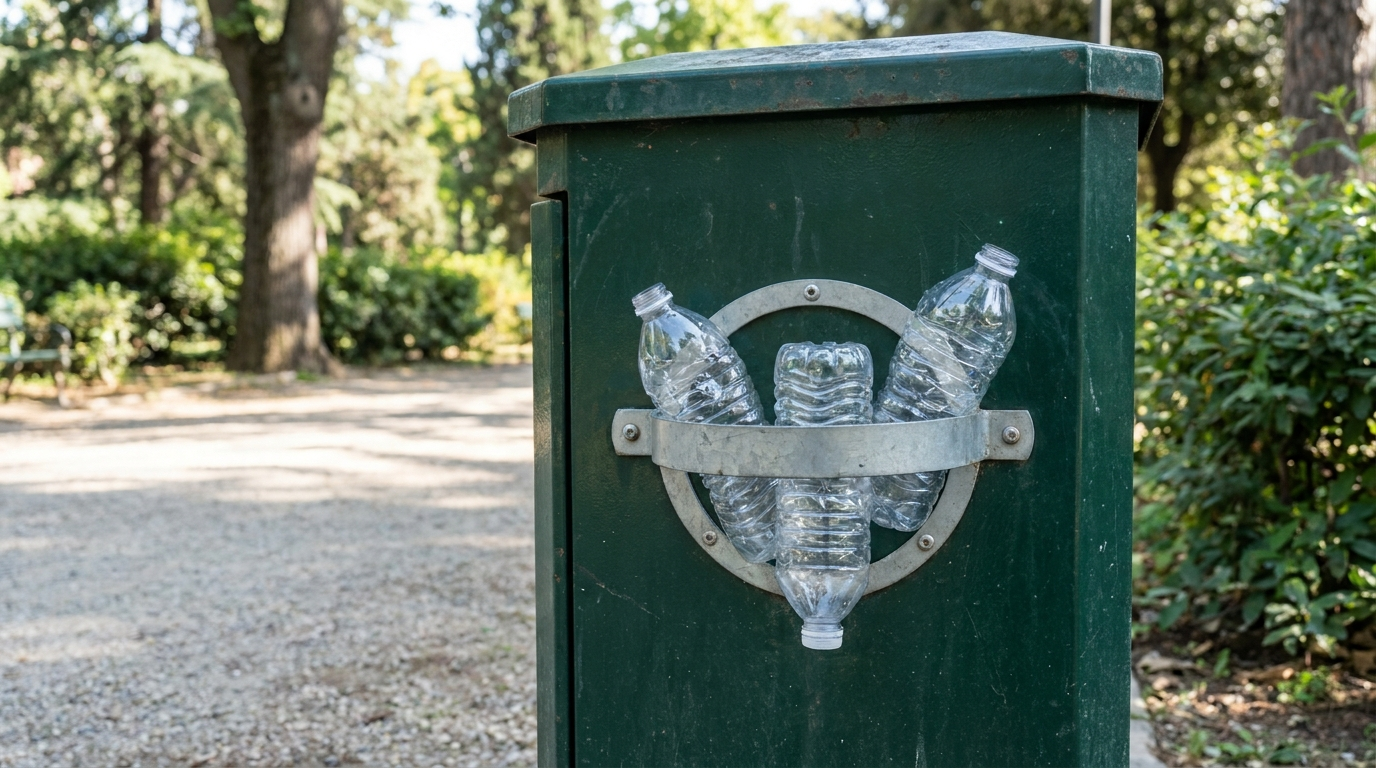
The Pfandring is a metal ring or small crate fixed to the outside of a public bin, letting bottles sit visibly on top instead of buried in the trash. Invented in Cologne in 2012, it had spread to roughly 110 German municipalities as an official program by 2021, according to Wikipedia’s entry on the device. Munich isn’t one of the cities running it as city policy, though. The installations that do exist around town, at spots like Theresienwiese, Hauptbahnhof, and along the Isar, have mostly come from volunteer groups such as Viva con Agua, and Munich’s own Abendzeitung newspaper has reported plainly that nobody, not the volunteers who install them, not the city itself, keeps up with maintaining them, so a fair number simply disappear over time.
| Option | How it works in Munich |
|---|---|
| Pfandring / Pfandkiste | Volunteer-installed only, no official city program, locations can disappear over time |
| "Pfand gehört daneben" | No physical object needed, just set your bottle beside or on top of the bin |
| Pfandgeben app | Best for larger quantities, arranges a direct pickup with a local collector |
The more durable, lower-effort option is simply following “Pfand gehört daneben,” deposit belongs next to it. The movement began with stickers designed and distributed by Matthias Gomille, spreading his message that bottle collectors shouldn’t have to dig through trash to find deposit bottles, and it reached Munich along with several other German cities. There’s no special equipment involved: you set your empty bottle on top of, or right next to, a public bin rather than dropping it inside, which is enough for a collector to spot and take it without touching anything else in the bin.
What Real People Say
The scale of what’s actually at stake here is worth sitting with. A citizen participatory-budget proposal for Munich, published on the city’s own unser.muenchen.de platform, cited a figure of roughly 180 million euros in deposit value thrown away by Munich residents every year, framing the core problem as one of both wasted resources and the indignity of forcing bottle collectors to search through garbage to recover any of it. That specific number comes from a single citizen proposal rather than an audited city statistic, so it’s best treated as an illustration of scale rather than a precisely verified figure, but even directionally, it points to a genuinely large amount of deposit value going unclaimed every year in the city.
Given that Munich doesn’t run an official Pfandring program the way many other German cities do, the practical reality is that “Pfand gehört daneben” is the more reliable habit to adopt here: it works regardless of whether a specific bin happens to have a ring attached that day, and it doesn’t depend on a volunteer-maintained installation still being there when you need it.
Step by Step
- Don’t count on finding an official Pfandring at your local bin. Munich has no citywide program, existing installations are volunteer-run and can disappear.
- Default to “Pfand gehört daneben”: set your empty bottle beside or on top of the bin rather than inside it, this works at any bin, with or without a ring attached.
- If you do spot a Pfandring or Pfandkiste, especially around Theresienwiese, Hauptbahnhof, or the Isar, feel free to use it, but don’t rely on one being there every time.
- For a larger batch of bottles, consider the Pfandgeben app to arrange a direct pickup with a local collector instead of leaving them in a public spot.
- Keep bottles reasonably clean and intact when leaving them out, this makes it easier and more dignified for a collector to take and redeem them.
Compliance Note
This page describes informal, volunteer-driven practices around bottle deposit donation in Munich, current as of mid-2026, not an official city program or legal requirement. Availability of specific Pfandring or Pfandkiste installations can change without notice.
FAQ & Common Pitfalls
Is there an official Munich city program for bottle-holder rings on public bins?
No. Unlike roughly 110 other German municipalities that have adopted the Pfandring as an official program, Munich has none. The installations that do exist, near Theresienwiese, Hauptbahnhof, and the Isar, are volunteer efforts, notably by the group Viva con Agua, and a local newspaper has reported that neither the volunteers nor the city maintain them consistently, so many get lost or removed over time.
What's the simplest thing I can actually do if I want my bottle to reach a collector?
Set it beside or on top of a public trash bin rather than dropping it inside. This is the entire idea behind 'Pfand gehört daneben' (deposit belongs next to it), a movement that started with stickers spreading the message and has reached Munich along with several other German cities. It doesn't require finding a specific Pfandring, just a small change in where you leave the bottle.
Is there a way to give a larger batch of bottles directly to a collector rather than leaving them out?
Yes, an app called Pfandgeben exists specifically to connect people who have deposit bottles to give away with local collectors, letting you arrange a pickup rather than leaving bottles in a public spot and hoping.
How much deposit value are we actually talking about here?
A citizen participatory-budget proposal for Munich cited a figure of roughly 180 million euros in deposit value thrown away by Munich residents annually. That figure comes from a single citizen proposal rather than an official city audit, so treat it as an illustrative estimate of the scale rather than a precisely verified statistic, but it's a genuinely large number by any measure.