
Starting Solids in Germany: What Gesund ins Leben Actually Recommends
Germany's official early-life nutrition network, Netzwerk Gesund ins Leben, recommends starting Beikost (solid food) no earlier than the start of month 5 and no later than month 7, with your baby's individual readiness signs, holding their head steady, sitting with support, not immediately pushing food back out with their tongue, and showing real interest in what you're eating, deciding the exact timing within that window rather than the calendar date alone. On the Brei (puree) versus Baby-led Weaning (BLW) question, the network's own guidance is that you don't have to choose one exclusively: finger food and spoon-fed puree aren't mutually exclusive, and combining both is entirely normal. BLW does require somewhat more developed motor skills, roughly 85 percent of babies can grasp small pieces of food by 6 to 7 months, rising to 96 percent by 7 to 8 months, but studies so far haven't found an increased choking risk specifically tied to BLW itself, as long as a few safety basics are followed: an upright sitting position, supervision at every meal, and avoiding genuinely high-risk foods like whole nuts, whole grapes, and raw hard vegetable pieces.
The Official Rule
If you’re trying to figure out exactly when to start solids and whether purees or baby-led weaning is the “right” approach, it’s worth knowing that Germany’s own official guidance is more flexible on both questions than a lot of advice you’ll find online suggests.
Netzwerk Gesund ins Leben, Germany’s official early-life nutrition network, recommends starting Beikost no earlier than the start of month 5 and no later than month 7. Within that window, your baby’s individual developmental readiness, not the calendar date alone, decides the actual right moment. The signs worth watching for: holding their head steady, sitting upright with support, no longer immediately pushing offered food back out with their tongue (a reflex that fades with development), and showing genuine interest in the food you’re eating.
| Puree (Brei) | Baby-led weaning (BLW) | |
|---|---|---|
| Typical starting readiness | Most babies can start around 5-6 months | Requires more motor development for grasping and chewing |
| Grasping ability | N/A, spoon-fed | ~85% of babies can grasp small pieces by 6-7 months, 96% by 7-8 months |
| Nutrient coverage | Reliable, based on structured meal planning | Depends heavily on what foods are actually offered |
| Official recommendation | Combining both approaches is normal, you don't need to choose exclusively | |
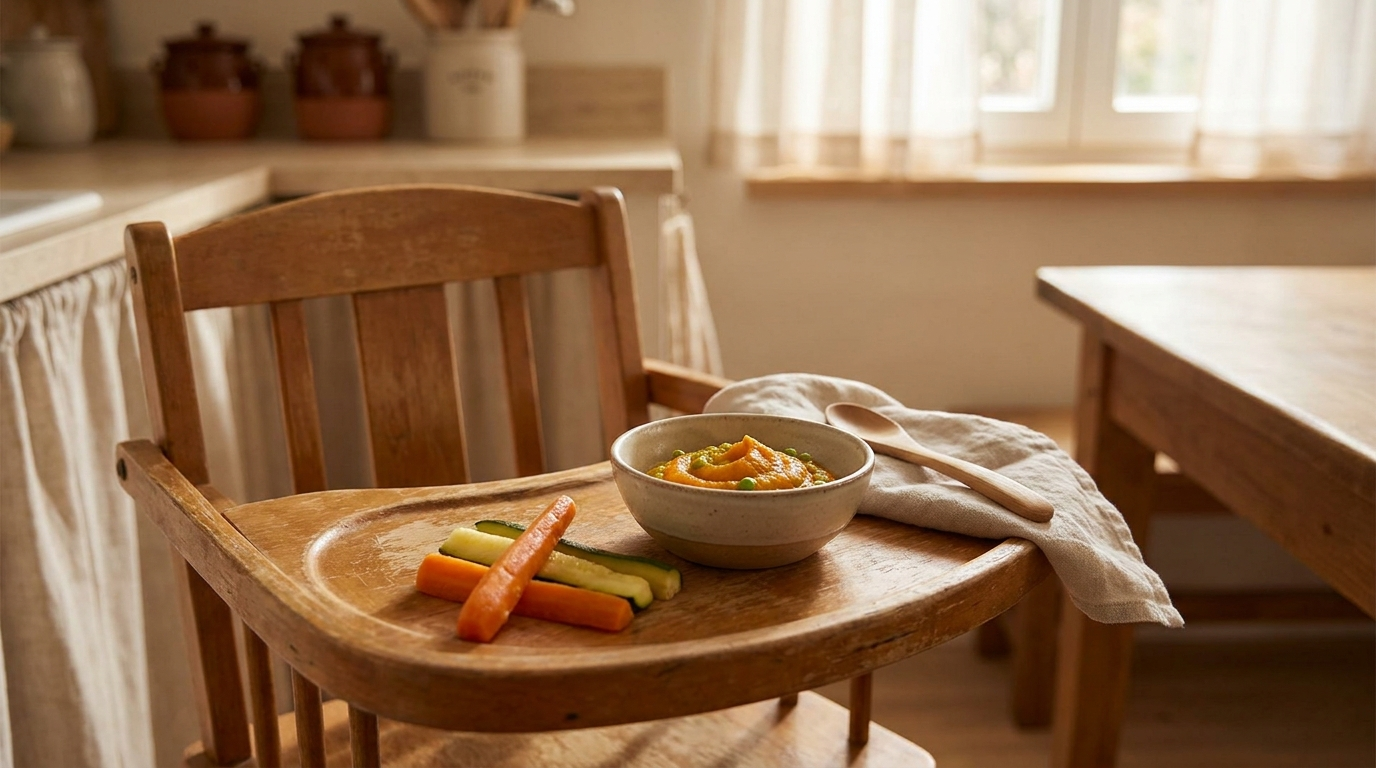
On the puree-versus-BLW question specifically, the official guidance doesn’t ask you to pick a side. Traditional Brei relies on structured, nutritionally calculated meal plans and most babies can start around 5 to 6 months, while baby-led weaning, where a baby feeds themselves pieces of food directly from the family table, requires somewhat more developed grasping and chewing ability: roughly 85 percent of babies can grasp small food pieces by 6 to 7 months, rising to 96 percent by 7 to 8 months. The guidance states plainly that finger food and spoon-fed puree aren’t mutually exclusive, combining both across different meals, or even within the same meal, is entirely normal.
What Real People Say
The choking-risk question is probably the single biggest source of anxiety around baby-led weaning, and it’s worth being precise about what the evidence actually shows: studies so far haven’t found an increased choking risk specifically tied to BLW itself, as long as some basic safety practices are followed consistently. That means an upright sitting position, supervision throughout the entire meal, letting your baby set their own pace rather than rushing them, and steering clear of genuinely high-risk foods regardless of which feeding method you’re using: whole nuts, whole grapes, berries, legumes, and raw hard vegetable pieces all carry real risk independent of the BLW-versus-puree question.
The practical takeaway many parents land on is treating this less as a binary choice and more as a flexible toolkit: purees on days when that’s easier, finger foods when your baby seems ready and interested, and no pressure to commit permanently to one label over the other.
Step by Step
- Watch for readiness signs rather than fixating on an exact week: steady head control, sitting with support, a fading tongue-thrust reflex, and genuine interest in your food.
- Don’t start before the beginning of month 5 or wait past month 7 without a specific reason discussed with your pediatrician.
- Feel free to combine purees and finger foods rather than committing exclusively to one method, this is explicitly normal per official guidance.
- Always have your baby sit upright and stay supervised for the entire meal, regardless of which feeding approach you’re using that day.
- Avoid whole nuts, whole grapes, berries, legumes, and raw hard vegetable pieces no matter which method you’re following, these carry real choking risk on their own.
- If you’re leaning toward baby-led weaning, wait until grasping and chewing ability seem genuinely present, rather than starting purely by calendar age.
Compliance Note
This page summarizes general guidance from Germany’s official early-life nutrition network, current as of mid-2026. It is not medical advice specific to your child. For questions about your baby’s individual readiness or any feeding concerns, consult your pediatrician (Kinderarzt) directly.
FAQ & Common Pitfalls
Is there a single 'correct' age to start solids, like exactly 6 months?
No, the official guidance sets a window, no earlier than the start of month 5 and no later than month 7, rather than one fixed date. Within that range, your baby's own readiness signs are what actually determine the right moment, not the calendar alone.
Do I have to pick either purees or baby-led weaning, not both?
No, and the official guidance is explicit that finger food and spoon-fed puree aren't mutually exclusive. Combining both approaches, offering purees at some meals and finger foods at others, or even both at the same meal, is entirely normal and doesn't require picking a single method.
Is baby-led weaning riskier for choking than purees?
Studies so far haven't found an increased choking risk specifically tied to BLW itself, as long as basic safety practices are followed: your baby sits upright, is supervised throughout the meal, eats at their own pace, and isn't offered genuinely high-risk foods like whole nuts, whole grapes, berries, legumes, or raw hard vegetable pieces.
What readiness signs should I actually watch for, beyond just my baby's age?
Key signs include being able to hold their head steady and sit with support, no longer immediately pushing offered food back out with their tongue (the fading of the tongue-thrust reflex), and showing genuine interest in the food you're eating. These matter more than hitting a specific week or month on the calendar.