
Berlin's Holiday Calendar and Sunday Closing: The Real Rules Behind the Quiet Days and the Corner Späti
Berlin observes 10 public holidays a year, three fewer than Bavaria's 13, and one of them barely exists anywhere else in the country: Internationaler Frauentag on March 8, a paid holiday in Berlin since 2019 and, since Mecklenburg-Vorpommern adopted it in 2023, in only one other German state. Missing entirely from Berlin's calendar are Heilige Drei Könige, Fronleichnam, Mariä Himmelfahrt, and Allerheiligen, all real days off in Bavaria and other Catholic-majority states. Underneath that calendar sits a separate, stricter rule: shops must close completely on every Sunday and every holiday under the Berliner Ladenöffnungsgesetz, with narrow named exceptions. Flower shops, bakeries, newspaper kiosks, and dairy stands can open 07:00 to 16:00, souvenir and tourist shops can open 13:00 to 20:00, and shops inside train stations, airports, and at gas stations face no time limit at all, which is why supermarkets like the Rewe at Ostbahnhof, the Edeka inside Bahnhof Friedrichstraße, and the denn's Biomarkt at Hauptbahnhof genuinely stay open on Sundays. The corner Späti is murkier: some are legally open because they hold a separate Gaststätte (restaurant) license that lets them sell drinks and snacks any day under an entirely different law, while others are simply operating in a tolerated gray zone the Senate has periodically threatened to shut down. As for the stiller Feiertag dance ban, Berlin's version is dramatically narrower than Bavaria's: only three days are protected at all (Karfreitag, Volkstrauertag, Totensonntag), and the ban on public dancing runs from just 4am to 9pm, so clubs can legally reopen for dancing that same evening.
The Official Rule
Berlin’s holiday calendar is shorter than most newcomers expect, especially anyone arriving with a Bavaria-shaped mental model. According to Berlin’s official tourism portal, the city observes exactly 10 statutory public holidays: Neujahr (January 1), Internationaler Frauentag (March 8), Karfreitag, Ostermontag, Tag der Arbeit (May 1), Christi Himmelfahrt, Pfingstmontag, Tag der Deutschen Einheit (October 3), and the two Christmas days. That’s three fewer than Bavaria’s 13. Entirely absent from Berlin’s list: Heilige Drei Könige (January 6), Fronleichnam, Mariä Himmelfahrt (August 15), and Allerheiligen (November 1), all real, paid days off in Bavaria and other Catholic-majority states. If you’re comparing notes with a colleague who moved from Munich, don’t assume your calendars line up.
| Holiday | 2026 | 2027 |
|---|---|---|
| Neujahr | Jan 1 (Thu) | Jan 1 (Fri) |
| Internationaler Frauentag | Mar 8 (Sun) | Mar 8 (Mon) |
| Karfreitag | Apr 3 (Fri) | Mar 26 (Fri) |
| Ostermontag | Apr 6 (Mon) | Mar 29 (Mon) |
| Tag der Arbeit | May 1 (Fri) | May 1 (Sat) |
| Christi Himmelfahrt | May 14 (Thu) | May 6 (Thu) |
| Pfingstmontag | May 25 (Mon) | May 17 (Mon) |
| Tag der Deutschen Einheit | Oct 3 (Sat) | Oct 3 (Sun) |
| Weihnachten (1st day) | Dec 25 (Fri) | Dec 25 (Sat) |
| Weihnachten (2nd day) | Dec 26 (Sat) | Dec 26 (Sun) |
March 8 is the one worth understanding properly, because its status is genuinely unusual. Berlin’s Abgeordnetenhaus added Internationaler Frauentag as a paid public holiday starting in 2019, making Berlin the first place in Germany to do so. Mecklenburg-Vorpommern followed in 2023. That means, as of 2026, it’s a holiday in exactly two of Germany’s 16 states, and Berlin is the only city-state among them. Notice from the table above that in 2026 it falls on a Sunday, so it doesn’t hand Berlin an extra day off that year, while in 2027 it lands on a Monday and does. It’s worth checking which weekday it falls on each year before assuming you’ve got a long weekend.
Underneath the holiday calendar sits a separate, stricter rule about ordinary Sundays. Berlin’s own government is direct about it: “An Sonn- und Feiertagen müssen Verkaufsstellen grundsätzlich geschlossen bleiben” (shops must, as a general rule, remain closed on Sundays and holidays), according to the official Ladenöffnungszeiten page. This is set by the Berliner Ladenöffnungsgesetz (BerlLadÖffG), and the exceptions are specific rather than a general grace period for “just a quick errand.”
| Category | Legal basis | Hours allowed |
|---|---|---|
| Souvenirs, maps, guidebooks, tobacco, film, immediate-consumption goods | Section 4(1) No. 1 | 13:00 to 20:00 |
| Flowers, plants, newspapers, bakery goods, dairy products | Section 4(1) No. 3 | 07:00 to 16:00 |
| Gas stations, pharmacies, train/airport/bus station shops | Section 5 | No time restriction |
| Verkaufsoffene Sonntage, citywide ordinance | Section 6(1) | Up to 8 days/year, 13:00 to 20:00 |
| Verkaufsoffene Sonntage, individual store request | Section 6(2) | 2 more days/year, 2 weeks' notice to the district office |
The station exception is the one that actually gets you a real Sunday grocery run. Berlin’s own city portal lists which supermarkets qualify: the Rewe at Ostbahnhof, the Edeka inside Bahnhof Friedrichstraße, and the denn’s Biomarkt at Hauptbahnhof. The Rewe at Hauptbahnhof’s Europaplatz specifically runs 08:00 to 22:00 on Sundays according to its own store page, a genuinely useful window if you’ve run out of something on a Sunday afternoon. None of this extends to a regular neighborhood Rewe or Edeka just because it’s large or busy: the exception is tied to the location (inside a station, at a gas station, or a pharmacy), not the size or popularity of the shop.
- 1 Ostbahnhof: Rewe, open Sundays and holidays
- 2 Bahnhof Friedrichstraße: Edeka, open Sundays and holidays
- 3 Hauptbahnhof: denn's Biomarkt, plus the Rewe on Europaplatz (08:00 to 22:00 Sundays)
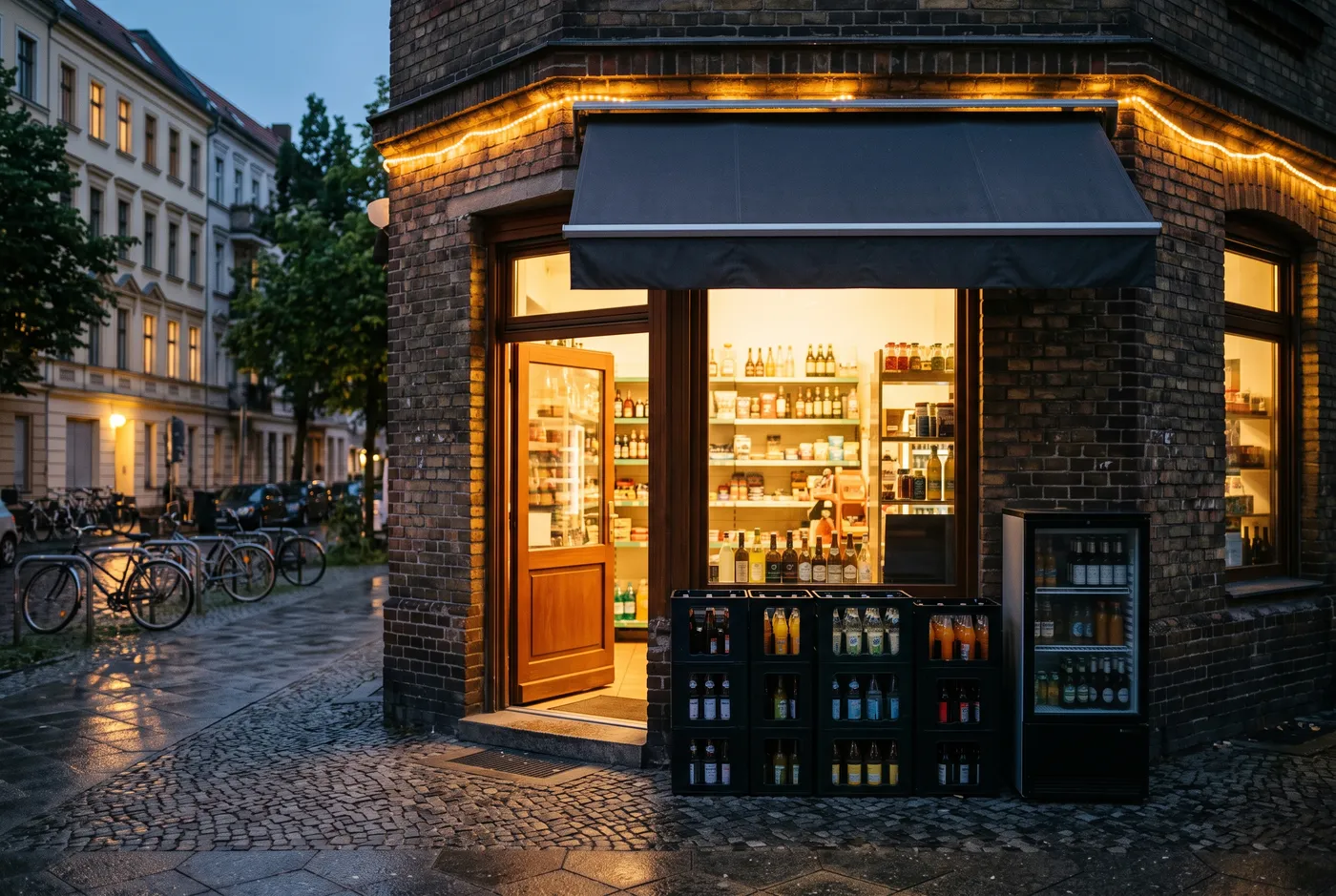
The corner Späti is a different, murkier story, and it’s worth understanding why rather than just trusting whichever one happens to be lit up. A genuine legal channel exists: a shop holding a Gaststättenerlaubnis (restaurant and bar license) operates under the Gaststättengesetz rather than the Ladenöffnungsgesetz, and under section 7 GastG it can sell drinks and prepared food plus accessories, bottled beer, non-alcoholic drinks, press, tobacco, and confectionery, on any day of the week, including Sunday. According to a legal analysis from haerting.de, it doesn’t matter which product category makes up the bulk of turnover, only that the Gaststätte is genuinely operated as one. That’s a real, defensible legal path to Sunday trading. But plenty of Spätis never bothered to get that license, and for those, Sunday opening sits outside the rules entirely. taz reported plainly that Sunday opening “war vorher zwar normal in Berlin, legal war es freilich nie. Es wurde geduldet” (was normal in Berlin before, but it was never actually legal, it was simply tolerated), and Berlin’s own labor senator has said publicly that operators without the right license are breaking the law, with periodic crackdown announcements that come and go. The practical upshot: some open Spätis are on solid legal ground, some are just being left alone for now, and there’s no way to tell which is which by looking at the door.
Berlin’s version of the stille Feiertag dance ban is where the gap with Bavaria is starkest. The official Berlin government page on Sonn- und Feiertagsrecht names exactly three protected stille Tage: Karfreitag, Volkstrauertag, and Totensonntag, governed by paragraph 4 of the Feiertagsschutzverordnung (FSchVO). Bavaria protects nine such days, including Aschermittwoch, Gründonnerstag, Karsamstag, Allerheiligen, Buß- und Bettag, and Heiliger Abend, none of which carry any special restriction in Berlin at all. The hours are narrower too. A 2019 written answer from Berlin’s Senatsverwaltung für Inneres to the Abgeordnetenhaus states it directly: under paragraph 4 no. 3 FSchVO, public dance events on Karfreitag, Totensonntag, and Volkstrauertag are banned “in der Zeit von 4:00 Uhr bis 21:00 Uhr” (from 4:00 to 21:00), and the same document draws out the implication itself, that dancing is legally permitted again after 21:00 on those same days. Compare that to Bavaria, where the Tanzverbot on Karfreitag runs effectively the entire day. General noise and work restrictions under paragraph 2 FSchVO still apply on every Sunday and holiday, not just the three stille Tage, but the dance-specific ban is the part that surprises people, and in Berlin it’s both shorter in list and shorter in hours.
How seriously any of this actually gets enforced is its own answer. That same 2019 parliamentary response breaks down district-level FSchVO cases for 2017 and 2018: Charlottenburg-Wilmersdorf, Treptow-Köpenick, Lichtenberg, Pankow, Mitte, Marzahn-Hellersdorf, and Reinickendorf reported zero violations in either year. Neukölln fined one shop-hours violation (paragraph 2 in connection with paragraph 5 FSchVO) 250 euros in 2017. Friedrichshain-Kreuzberg fined two dance events, a Totensonntag event in 2017 and a Karfreitag event in 2018, 100 euros each. Tempelhof-Schöneberg fined one Sonn- und Feiertagsruhe case 100 euros in 2017. One district told the Senat outright that the FSchVO “kaum wirksam vollzugsfähig sei” (is barely enforceable in practice), that the Ordnungsamt mostly acts on specific tips from neighbors, and that plenty of venues sidestep the dance ban entirely by declaring an event a training or practice session, a common move for dance schools, or by restricting entry to a closed private group. If you’re weighing whether to actually respect these rules or just hope nobody notices, the honest answer from Berlin’s own records is that enforcement is real but genuinely rare.
What Real People Say
General culture-shock writing about Germany treats the Sunday closure itself as a near-universal shock, Berlin included. One expat blog puts the exceptions plainly: “You cannot go shopping on Sundays in Germany. There are a few exceptions, like small corner shops, a few grocery stores in U-bahn main stations.” Another guide frames the whole day around the closures rather than despite them: “Sundays are a day of rest, and everything is closed, except restaurants.”
Berlin-specific writing goes further and treats the Späti less as a workaround and more as its own institution. Berlin Walk, a local expat guide, describes it as “one of the places where Berlin keeps running when the official city has gone quiet,” and doesn’t hide the disorientation newcomers feel the first time the ordinary retail grid switches off: arriving on a Sunday, it notes, can make the whole city feel like “someone turned the retail system off.” The same guide is upfront that Spätis cost more than a supermarket, so they’re a real backup for small items, not a substitute for Saturday’s real shopping trip. The Spectator goes into where the format actually comes from: Spätis trace back to shops that popped up in the former East Germany for workers finishing evening shifts, and the piece describes today’s version as continuing “a quiet and benign form of East German egalitarianism,” complete with outdoor benches, roughly 1.50-euro bottles of beer, and a wegbier (takeaway drink) culture that turns the shop itself into a small social space.
On YouTube, the short “Why Berliners love their Spätis” covers the same territory for viewers who’ve never encountered the concept: a shop that’s simultaneously a late-night convenience store, a social hangout, and, depending on the specific address, either a fully licensed Gaststätte or a shop nobody’s gotten around to fining yet.
Step by Step
- Check the current year’s official Berlin holiday list before assuming a long weekend, since several dates move with Easter and Internationaler Frauentag’s weekday changes year to year, which decides whether March 8 actually gives you a day off.
- Do your real grocery shopping on Saturday. Assume every ordinary shop, including large supermarkets, is closed on Sunday and on all 10 holidays.
- If you genuinely need something on a Sunday, go to a train or airport station shop, a pharmacy, or a gas station first. These have no time restriction under section 5 BerlLadÖffG and are the most reliable option, not a nearby Späti you’re hoping is open.
- Don’t treat an open Späti as guaranteed or automatically legal. Some hold a real Gaststättenerlaubnis and are fully within the rules; others are simply being tolerated for now. Either way, it’s a backup option, not a certainty.
- If you’re organizing a public dance event, only Karfreitag, Volkstrauertag, and Totensonntag carry any restriction in Berlin, and only from 4:00 to 21:00. Evenings on those same days are clear, and no other stille Tag applies here the way it would in Bavaria.
- If you want to report a Sunday or holiday violation, that goes to your district’s Ordnungsamt, not the police. Berlin’s own enforcement data shows this is complaint-driven and inconsistent across districts, so don’t expect a fast or certain outcome.
Compliance Note
This page explains the general framework for Berlin’s public holidays, Sunday shop-closing rules, and stille Feiertage restrictions, current as of mid-2026. It is not legal advice. Holiday dates, opening-hour exceptions, and enforcement practices can change or vary by district, confirm current rules directly with the Land Berlin or your district’s Ordnungsamt before relying on any of the exceptions described here.
FAQ & Common Pitfalls
Is March 8 really only a holiday in Berlin?
It was, from 2019 until 2022. Berlin's Abgeordnetenhaus voted to add Internationaler Frauentag as the state's tenth public holiday in 2019, making Berlin the first place in Germany to give workers March 8 off. Mecklenburg-Vorpommern followed in 2023, so today it's one of only two of Germany's 16 states with the holiday. Berlin remains the only city-state that observes it, and it still doesn't exist in Bavaria, North Rhine-Westphalia, or any of the other 14 states, so don't assume a colleague or employer based elsewhere in the country has the same day off.
If a supermarket near me is closed on Sunday, is there anywhere in Berlin that's reliably open?
Yes, but it's a short, specific list rather than a general rule. Berlin's own city portal names the Rewe at Ostbahnhof, the Edeka inside Bahnhof Friedrichstraße, and the denn's Biomarkt at Hauptbahnhof as supermarkets that genuinely open on Sundays and holidays, because shops located inside train stations, airports, and at gas stations face no Sunday time restriction under the Ladenöffnungsgesetz. A regular neighborhood supermarket, even a large one, does not get this exception just because it wants to.
Are Spätis actually legal to be open on Sundays, or is everyone just breaking the law?
It genuinely depends on the shop. A Späti that holds a Gaststättenerlaubnis (restaurant and bar license) can sell drinks, prepared food, and accessories like bottled beer, non-alcoholic drinks, press, and tobacco on any day, including Sunday, because the Gaststättengesetz takes precedence over the shop-closing law for a genuinely operated Gaststätte, regardless of what share of turnover comes from which product category. Spätis without that license are not covered by any special exception. As taz has reported, Sunday opening for those shops was normal in Berlin but never actually legal, it was simply tolerated, and the Senate's own labor senator has stated publicly that operators without the right license are violating the law, with periodic announcements of stepped-up enforcement. In practice, don't assume every open Späti you see is operating within the rules, and don't assume a closed one is either.
What exactly is banned on a stiller Feiertag in Berlin, and does it affect a private party?
Berlin protects just three stille Tage under paragraph 4 of the Feiertagsschutzverordnung (FSchVO): Karfreitag, Volkstrauertag, and Totensonntag. On those three days, public dance events are banned specifically from 4:00 to 21:00, which the state government itself has confirmed means dancing is legally allowed again after 21:00 on the very same day. It only reaches public events. A private, invitation-only party or wedding in a closed setting isn't covered by the FSchVO's dance restriction at all.
How strictly are these rules actually enforced in Berlin?
Inconsistently, and district by district. A 2019 written answer to Berlin's parliament covering 2017 and 2018 shows that Charlottenburg-Wilmersdorf, Treptow-Köpenick, Lichtenberg, Pankow, Mitte, Marzahn-Hellersdorf, and Reinickendorf recorded zero FSchVO violations in either year. Neukölln fined one shop-hours case 250 euros, Friedrichshain-Kreuzberg fined two dance events (one on Totensonntag, one on Karfreitag) 100 euros each, and Tempelhof-Schöneberg fined one Sonn- und Feiertagsruhe case 100 euros. One district told the Senat directly that the FSchVO is barely enforceable in practice, since the Ordnungsamt mostly reacts to specific tips from neighbors, and plenty of venues get around the dance ban by declaring an event a training or practice session (common for dance schools) or restricting it to a closed private group.