
Your Child's Bike Test in Grade 4: What Munich's Radfahrausbildung Actually Involves
Bavaria has run a mandatory school bicycle training program since the 2004/05 school year, anchored in a joint 2003 decree from the Bavarian Ministries of the Interior and of Education (2230.1.3-K). The program spans grades 2 through 4: in grades 2 and 3, only your child's own class teacher runs protected-space practice sessions building basic bike handling, and this groundwork is a mandatory prerequisite before the real program starts. In grade 4, trained police traffic educators take over the practical training at a Jugendverkehrsschule, four practice units in a protected space plus one unit riding in actual traffic, spread over no more than 10 weeks, with the class teacher required to stay present throughout. Training ends with a Radfahrprüfung in two parts, a 20-question written test graded strictly pass or fail and never counted toward any subject grade, plus a practical test combining an individual ride on a fixed course and a group ride with free route choice. If a child doesn't pass, there's no legal consequence at all, parents are simply informed of the reasons and usually offered a repeat practice session. Helmets are mandatory for the real-traffic unit, and Verkehrswacht München lends bicycles and coaching to Munich elementary and special-needs schools free of charge for the earlier grades.
The Official Rule
Bicycle training in Bavarian elementary schools isn’t an occasional field trip, it’s a legally anchored, mandatory part of the curriculum, and it’s been that way since the 2004/05 school year. The framework comes from a joint decree issued on 15 May 2003 by the Bavarian Ministries of the Interior and of Education, reference 2230.1.3-K, and it lays out a genuinely specific structure rather than leaving the details to individual schools.
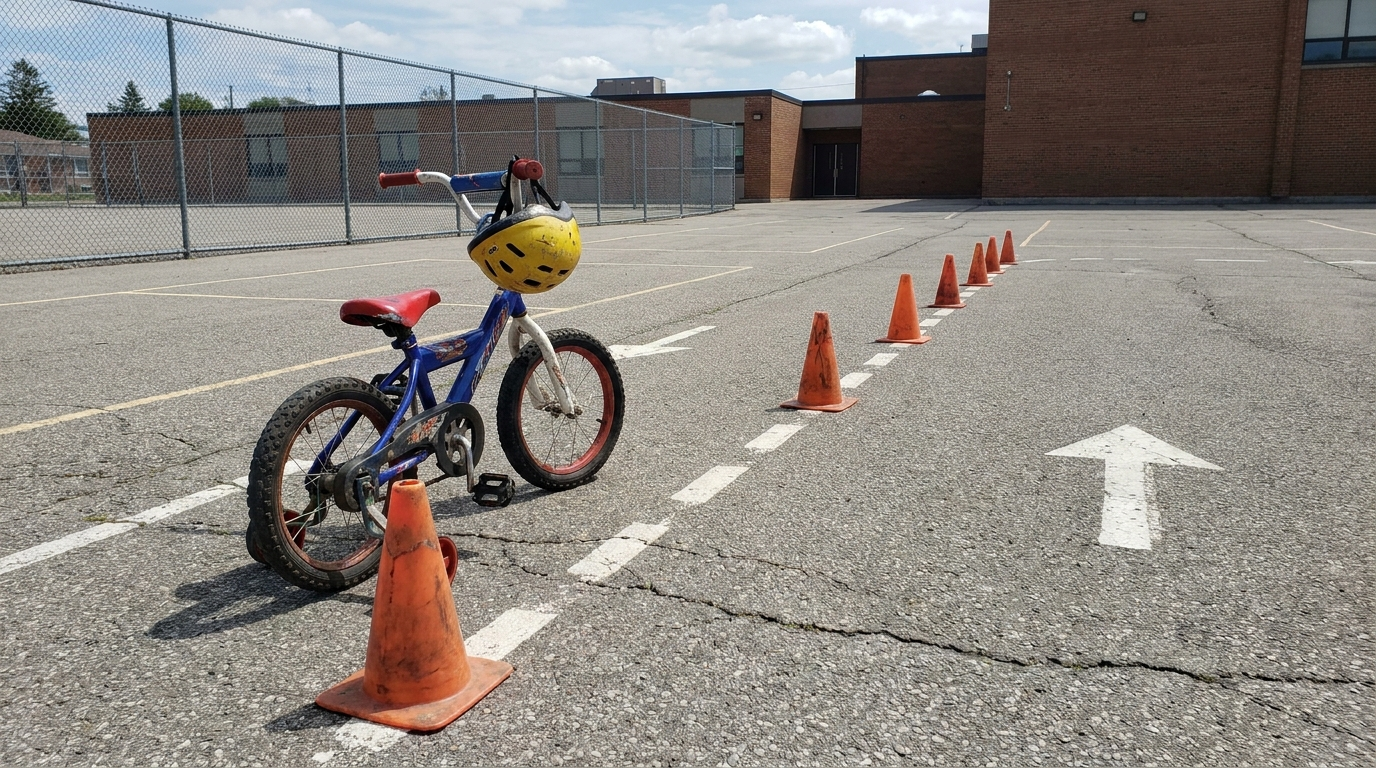
Responsibility for the whole program sits with the school, but it splits sharply by grade. In grades 2 and 3, the protected-space practice sessions, Schonraumübungen, are run exclusively by your child’s own class teacher, police traffic educators can be consulted for advice but don’t lead these earlier sessions. This groundwork isn’t optional extra credit, the decree explicitly requires it as the foundation before Jugendverkehrsschule training in grade 4 can begin.
Grade 4 is where the practical training actually shifts to police-led instruction at a Jugendverkehrsschule, a youth traffic school, either a mobile setup that visits the school or a stationary site. Trained police traffic educators (Verkehrserzieher der Polizei) run the hands-on riding practice, but the class teacher has to be present throughout and assists, including flagging any student’s specific motor difficulties, disabilities, or health limitations to the officers beforehand.
| Grade | What happens | Who runs it |
|---|---|---|
| 2-3 | Protected-space (Schonraum) practice, mandatory groundwork | Class teacher only |
| 4 (theory) | Traffic rules and bicycle safety instruction | Class teacher |
| 4 (practical) | 4 protected-space units + 1 real-traffic unit, over max. 10 weeks | Police traffic educators, teacher present |
| 4 (exam) | Written test (20 questions) + practical ride | Teacher (written) / police (practical) |
The practical training itself is tightly timed: four practice units in a protected space plus one unit riding in actual traffic, and the whole sequence is meant to stay within a 10-week window. Each unit works through a specific skill set, starting with basics like pulling away from the curb and giving way at right-of-way junctions, moving up through left turns at increasingly complex intersections, and finishing with an individual test on a fixed course plus a group test where children choose their own route. The blind spot (toter Winkel) has to be explained hands-on somewhere within these four units, not just described in a classroom.
Training closes with the Radfahrprüfung, and it’s a two-part exam, not a single pass/fail moment. The written portion is a 20-question test sheet, approved centrally by the ministries rather than written by individual teachers, and it’s graded strictly as passed or not passed, the decree explicitly bars it from being folded into a subject grade. The practical portion happens at the Jugendverkehrsschule, run by the police traffic educators as an individual and/or group assessment, before the real-traffic unit.
If a child doesn’t pass, nothing about their legal ability to ride a bike changes, this exam carries no licensing weight in Germany. What does happen: parents are informed in an appropriate way, with the specific reasons for the result explained, and a fifth protected-space practice unit is generally offered as a repeat if staffing and time allow.
Helmets are a specific, named requirement for the real-traffic unit, the class teacher checks that the helmet actually fits and sits correctly, and the decree recommends, as a matter of setting a good example, that the accompanying police officers and any other adults involved wear helmets too.
What Real People Say
Munich’s own road safety association, Verkehrswacht München, goes a step further than the legal minimum: it supplies bicycles and hands-on practice guidance completely free of charge to elementary and special-needs schools across the city and district, specifically to support the earlier, teacher-led protected-space sessions. The national publisher behind the official training materials, VMS Verkehrswacht Medien & Service, also publishes its parent information guide in 12 languages including Turkish, alongside a plain-German version, a genuinely useful detail for a newly arrived family trying to understand what their child is actually doing at school for the next several weeks.
Munich press coverage from hallo-muenchen.de reported on why Bavaria is layering an earlier, multi-year approach on top of the existing structure: officials found that while roughly 90% of fourth-graders still pass the traditional exam, failure rates have been creeping up, with some children arriving at the grade 4 program never having been taught basic bike handling at home at all. Bavaria’s education minister, Anna Stolz, framed the earlier starting point as an attempt to build genuine motivation and skill over several years rather than cramming it all into a few weeks in grade 4.
English-language explainer Charlingua makes a point that reassures a lot of newly arrived parents worried about the stakes: failing the test means nothing changes, the child keeps riding exactly as before, since German children are expected to build independence in traffic gradually from an early age regardless of this specific exam’s outcome.
Step by Step
- Grades 2-3: support the teacher-led protected-space practice at home tooBasic bike handling built early makes the grade 4 program noticeably less stressful.
- Early grade 4: theory instruction from the class teacherTraffic rules, right-of-way, and bicycle safety basics, timed ahead of the practical units.
- Practice units 1-4 (protected space, within a 10-week window)Skills build from pulling off from the curb through increasingly complex left turns, with the blind spot explained hands-on somewhere in this stretch.
- Radfahrprüfung: written test, then practical testThe 20-question written test is pass/fail only. The practical test combines an individual ride on a fixed course and a group ride with free route choice.
- Practice unit 5 (real traffic)Requires passing both exam parts first. Helmets are mandatory here specifically, and the class teacher checks the fit.
- If your child doesn't passYou'll be informed of the specific reasons, and a repeat protected-space session is usually offered where possible.
Compliance Note
This page explains the general framework for mandatory school bicycle training in Bavaria under the 2003 ministerial decree, but specific scheduling, local Jugendverkehrsschule arrangements, and any newer pilot programs can vary by school and are actively evolving. For your child’s specific situation, confirm directly with their class teacher or the school administration.
FAQ & Common Pitfalls
We moved here mid-year and my child missed the grade 2-3 protected-space exercises. Can they still join the grade 4 program?
The official framework treats those earlier exercises as groundwork, but it doesn't spell out a rigid exclusion rule for a child who arrives without them, that judgment call sits with the class teacher, who's required to inform the police traffic educators about any student's specific gaps or limitations before the practical training starts. The most reliable move is to tell your child's teacher directly and early, rather than assuming the school will automatically catch a newcomer's missing groundwork on its own, and to spend some time practicing basic bike handling with your child at home in the meantime.
What if my child doesn't have their own bicycle?
The regulation's preference is for a child to train on their own roadworthy bicycle, but it explicitly allows for a school or Jugendverkehrsschule bicycle to be used instead when that's not available. Whichever bike is used, it gets checked for basic roadworthiness before the real-traffic unit, so this isn't a reason to worry about being excluded.
Does failing the Radfahrprüfung affect my child's grades or their ability to ride a bicycle afterward?
No, on both counts. The written test is graded exclusively as passed or not passed and is explicitly barred from counting toward any subject's grade, and failing the practical or written portion carries no legal consequence for your child riding a bike afterward, in Germany the test itself has no licensing authority. What happens practically is that parents are informed of the specific reasons for not passing, and a repeat practice session is generally offered where staffing allows.
I've read about a new Bavarian 'Radlführerschein' concept starting in grade 1. Does that replace the grade 2-4 program described here?
Not exactly, and it's worth not confusing the two. The core, legally anchored program described on this page (mandatory protected-space practice in grades 2-3, police-led training and the Radfahrprüfung in grade 4) has been the constant structure since 2004/05. What's newer is an earlier, multi-year layer that has parents walking the actual school route with their child starting in grade 1 and logging that in a bicycle passport, meant to catch children who arrive at grade 4 without solid basic riding skills. Since this earlier layer is still rolling out, confirm with your child's own school which version currently applies rather than assuming either description is universal yet.