
There's No Legal Age for Walking to School Alone in Munich, Here's What Actually Decides It
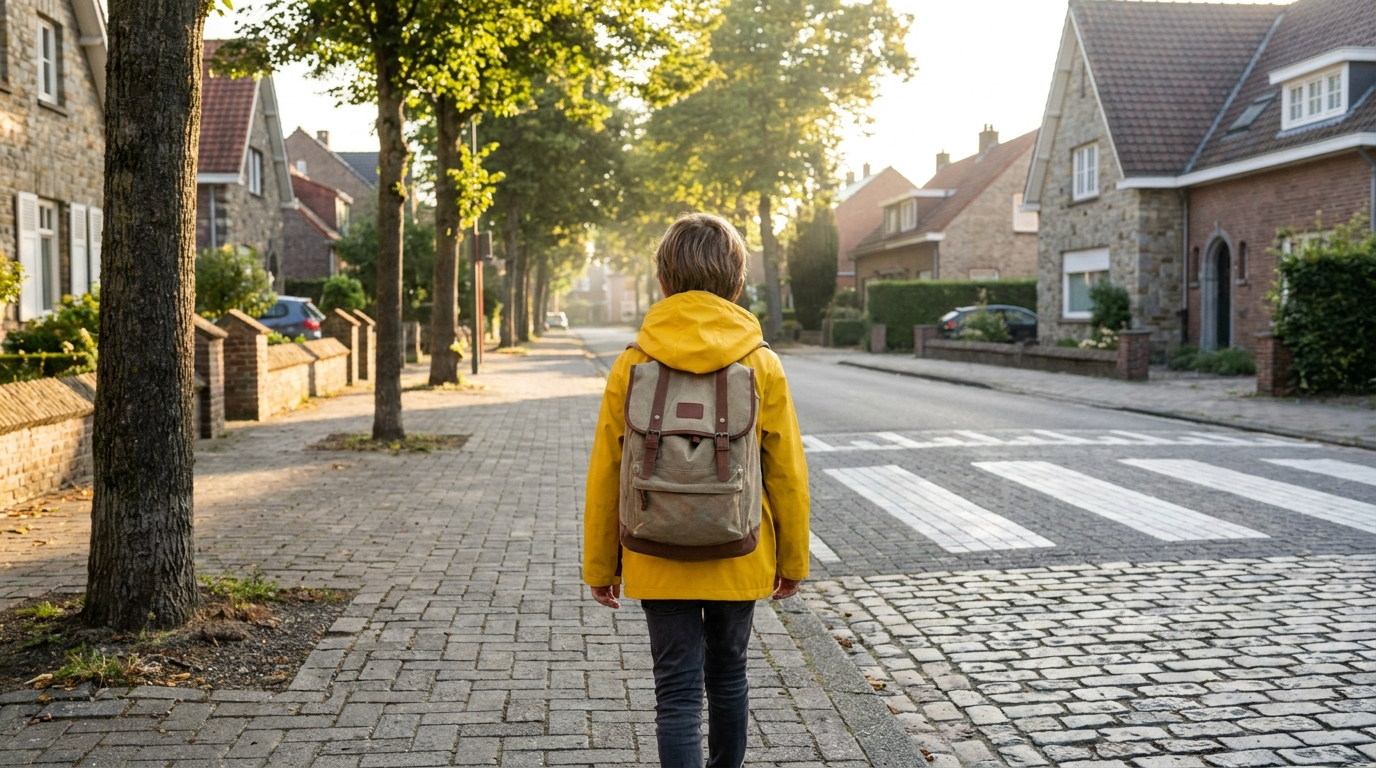
There's no fixed legal age in Germany or Bavaria for when a child can walk to school alone. Munich's own Mobilitätsreferat and named traffic-safety professionals are consistent on this point: the decision genuinely depends on a child's individual developmental readiness and traffic-risk awareness, not a birthday. In practice, most children reach this point somewhere between roughly 7 and 9 years old, with independence typically starting around age 8 on average, but that's descriptive, not a rule to plan around. What matters more than age is whether a child correctly reads traffic situations, not just seeing a car but predicting what it will do next, reacts appropriately under pressure, and has actually practiced the specific route repeatedly, not traffic skills in the abstract. Munich's official guidance recommends training the real route together first, then shortening how far you accompany your child day by day, and dressing them in bright clothing. One concrete legal fact that lowers the stakes of this decision: Germany's statutory accident insurance, administered in Bavaria by the KUVB (Kommunale Unfallversicherung Bayern), covers a child on the direct route to and from school regardless of whether they walk alone, accompanied, by bike, car, or transit, and regardless of how many times a day they make that direct trip. The only thing that voids it is a genuine detour taken for a personal reason unrelated to school.
The Official Rule
Unlike the specific age thresholds that govern, say, when a child can cycle on a sidewalk versus the road, there’s genuinely no fixed legal age in Germany, or specifically in Bavaria, for when a child can walk to school alone. This surprises a lot of newly arrived parents expecting a clean number to plan around, and it’s worth hearing directly from the professionals who actually work with this question.
Ben Zorzi, a social pedagogue (Sozialpädagoge B.A.) and director of a municipal children’s center, is explicit on this point in expert guidance published by Elternzeitung: “Einen genauen Zeitpunkt dafür kann man jedoch nicht festlegen, da es auch immer vom aktuellen Entwicklungsstand des Kindes abhängt.” A precise moment genuinely can’t be fixed, because it always depends on the child’s current developmental stage. What matters more than a birthday, in his framing, is whether a child has developed genuine risk awareness (angemessenes Risikobewusstsein) and can correctly interpret traffic situations, not just whether they can technically see and identify a car, but whether they can predict what that car is actually going to do next.
In practice, this tends to land somewhere between roughly 7 and 9 years old, with average independence typically starting around age 8, but this is a descriptive pattern drawn from typical development, not a threshold you should treat as a green light on its own. The individually right moment for a specific child depends on their observed maturity, the actual distance involved, and the real traffic conditions on their specific route, not a generic number.
| Signal | What it actually means |
|---|---|
| Predicts what a car will do, not just notices it | Genuine traffic-risk awareness, not just visual recognition |
| Reacts appropriately under time pressure or surprise | Can apply the rule in a real, imperfect moment, not just recite it |
| Has walked the specific route repeatedly, not traffic rules in general | Familiarity with this route's actual junctions and crossings, which don't generalize from a different street |
| Consistently uses the safer, not just the shortest, path | Judgment prioritizing safety over convenience |
Munich’s own Mobilitätsreferat, via muenchenunterwegs.de, frames an active, independently walked school route as something genuinely valuable for a child’s development, not simply a logistics problem to solve, “Ein aktiver Schulweg ist für Kinder wichtig. Er bedeutet Lernen und Erleben.” The city’s own tips lean toward choosing the safest route over the shortest one, and toward avoiding driving your child to school where it can reasonably be avoided, partly because fewer cars circling near the school gate genuinely makes conditions safer for every child walking there.
One concrete legal fact worth knowing regardless of how you decide this: Germany’s statutory school accident insurance genuinely doesn’t care whether your child walks alone or accompanied. In Bavaria, this coverage is administered by the KUVB, Kommunale Unfallversicherung Bayern, and it explicitly states that students are fundamentally free in their choice of how they get to school, “Schüler sind in der Wahl der Beförderungsmittel grundsätzlich frei,” and that supervision status doesn’t affect coverage. A genuine detour, like a missed bus forcing an alternate route, stays covered too. What actually ends coverage is the trip’s final underlying purpose (finale Handlungstendenz) shifting to something personal and unrelated to school, like a stop to shop or socialize.
What Real People Say
Munich police traffic educator Martin Seyfert (Polizeihauptmeister), quoted in the same Elternzeitung guidance, recommends a specifically gradual method rather than a single decision point: walk the actual route together multiple times before the school year starts, point out the genuinely safer crossings like signaled intersections rather than assuming any crossing is equally safe, and then, once your child starts walking ahead, follow a few meters behind to actually observe how they handle real situations rather than assuming based on how they described it. He also points to peer walking groups as a way to reduce how much direct parental accompaniment a child needs while still keeping real supervision in place during the transition.
School principal Melanie Heigl-Birk, in the same piece, adds a detail worth taking seriously: explain traffic rules with the reasoning behind them, not just the rule itself, so a child understands why a specific crossing matters rather than treating it as an arbitrary instruction to follow only when an adult happens to be watching.
Step by Step
- Walk the actual route together, repeatedly, before relying on itNot a generic safety talk, this specific route's junctions, crossings, and genuine trouble spots.
- Point out the safer crossings specifically, not just the shortest pathSignaled intersections and marked pedestrian crossings, explained with the reasoning behind them.
- Shorten how far you accompany your child, day by dayOnce they seem ready, walk with them to a slightly earlier point each day rather than switching to fully alone all at once.
- Follow a few meters behind once they're walking aheadObserve how they actually handle real traffic situations, rather than assuming based on a conversation.
- Consider a peer walking group as an intermediate stepReal supervision stays in place while building the same route-specific familiarity.
- Dress for visibility and confirm the insurance point isn't a factor either wayBright clothing helps drivers see your child, and Germany's statutory accident coverage applies to the direct school route regardless of whether they walk it alone or accompanied.
Compliance Note
This page explains the general professional guidance and legal framework around independent school travel in Germany and Bavaria, but there’s no fixed legal age, and the right moment for your specific child depends on their individual development and your own direct observation. This isn’t a substitute for your own judgment about your child’s readiness, and for questions about statutory accident insurance coverage in a specific situation, confirm directly with the KUVB or your child’s school.
FAQ & Common Pitfalls
Is there really no age at which German law says my child can walk to school alone?
Correct, there's no statutory age threshold for this specific decision, and the professionals quoted on the subject are explicit that a fixed age can't genuinely be set, since it depends on the individual child's developmental stage. What Germany does regulate concretely is a related but separate question, the age at which a child may legally cycle on a sidewalk versus the road, which follows specific thresholds under the StVO. Walking alone is left to parental judgment about readiness, not a fixed rule.
What's the actual practical method Munich recommends for building up independence?
A gradual, route-specific approach, not a single switch flipped on a birthday. Walk the real route together repeatedly first, ideally before the school year starts, pointing out the genuinely safer crossings, like signaled intersections and marked pedestrian crossings, rather than just the shortest path. Then shorten how far you accompany your child day by day, walking a few meters behind to observe once they've started going ahead, and extend the independent stretch gradually as they demonstrate they're handling it well.
Does the accident insurance still cover my child if they take a slightly different path one day, like avoiding a closed sidewalk?
Generally yes. The KUVB's own guidance is explicit that the deciding factor is the finale Handlungstendenz, the final underlying purpose of the trip, not an exact GPS match to one specific path. A reasonable variation still aimed at reaching or leaving school, including something like a missed bus forcing an alternate route, stays covered. What actually voids coverage is a detour genuinely motivated by a personal errand, like stopping to shop or socialize, unrelated to getting to or from school.
My child's school has a walking group, like Bus mit Füßen. Does that count as 'walking alone' for insurance or readiness purposes?
For insurance purposes, it doesn't change anything either way, the statutory coverage applies to the direct school route regardless of whether your child walks it alone, with a walking group, or accompanied by you personally. For the separate readiness question this page is really about, a supervised walking-bus group is generally a genuinely useful intermediate step, since it builds the same route-specific familiarity and traffic judgment in a lower-stakes, adult-supervised setting before a child transitions to walking that stretch fully alone.