
The TÜV Sticker: How Germany's Vehicle Inspection Deadline Actually Works
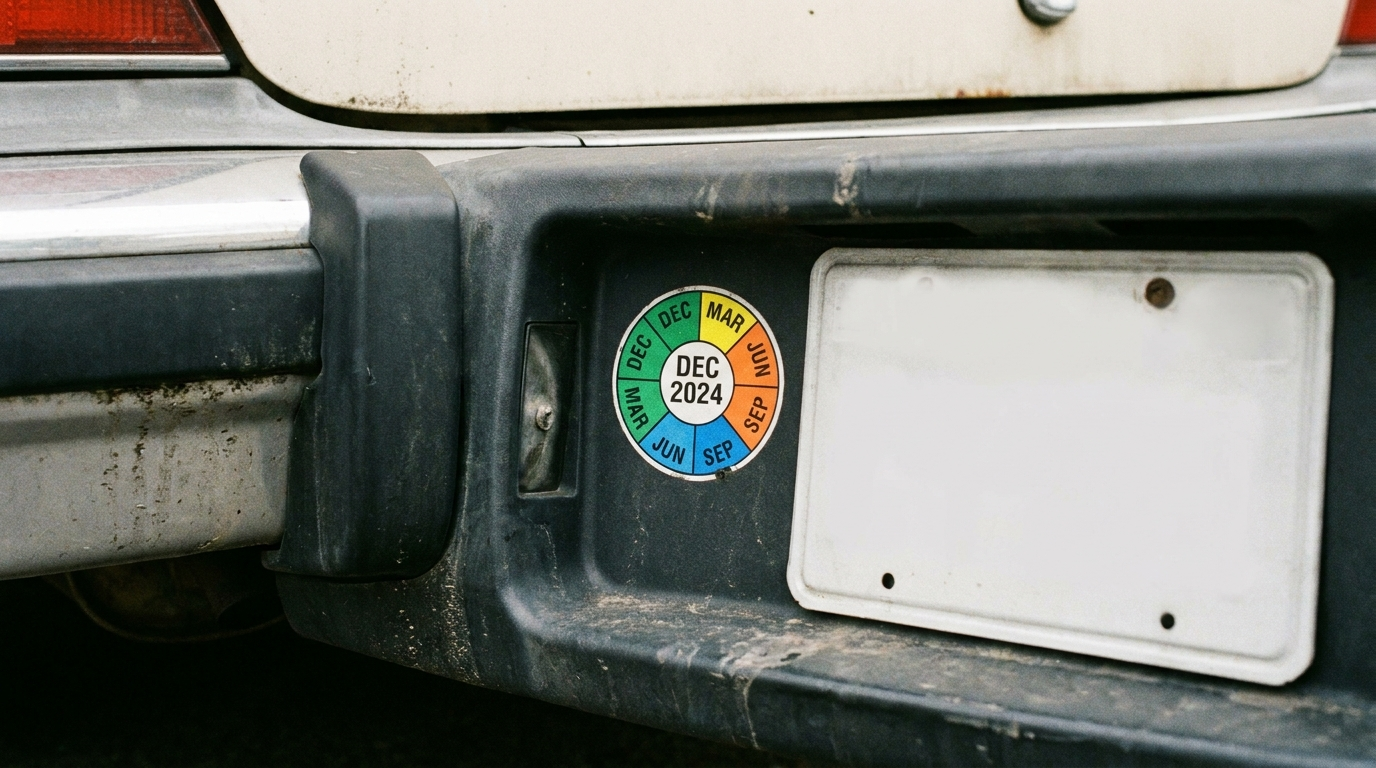
Germany requires every registered car to pass a periodic technical inspection, the Hauptuntersuchung (HU), commonly just called 'TÜV' after the best-known inspection organization even though DEKRA, GTÜ, and KÜS all perform it too. The legal basis is Section 29 of the StVZO (Straßenverkehrs-Zulassungs-Ordnung), and for most passenger cars the interval is every 2 years, with new cars getting a longer first grace period of 36 months before their very first inspection. A round sticker on your rear license plate shows your deadline: the year sits in the center, the month at the 12 o'clock position, and the color rotates through a fixed six-year sequence, 2026 is a blue year. Miss the deadline and the consequences are tiered rather than immediate: under 2 months overdue typically gets you only a verbal warning, 2 to 4 months overdue carries a 15 euro fine, 4 to 8 months overdue rises to 25 euros, and past 8 months overdue the fine jumps to 60 euros plus a point on your record at the Flensburg driver register. There's also a real, if harder to trigger, insurance risk: driving with a lapsed HU doesn't void your liability coverage, but your insurer can pursue you personally for up to 5,000 euros if they can show the lapse amounted to gross negligence that contributed to an accident.
The Official Rule
If you’re used to a country where vehicle inspection either doesn’t exist or works completely differently, Germany’s system can feel oddly analog at first: a small round sticker on your rear license plate is, quite literally, the entire notification system for your inspection deadline. No app reminder, no automatic renewal notice by default, just a sticker you’re expected to notice yourself.
StVZO Section 29, Germany’s vehicle registration regulation, sets the legal requirement, and Anlage VIII spells out the exact intervals. For most passenger cars, inspection is required every 2 years. New cars get a longer runway before their first one: 36 months from first registration rather than 24. A few vehicle categories run on a tighter, annual schedule regardless of age: taxis and vehicles used for passenger transport under the Personenbeförderungsgesetz, ambulances and disabled-transport vehicles seating up to 8, and rental cars offered commercially without a driver.
| Time overdue | Fine | Flensburg point |
|---|---|---|
| Under 2 months | Typically a warning only | No |
| 2 to 4 months | 15 euros | No |
| 4 to 8 months | 25 euros | No |
| Over 8 months | 60 euros | Yes, 1 point |
The fine structure comes directly from the official Bußgeldkatalog-Verordnung, Germany’s federal fine catalog. Being under 2 months overdue is generally treated leniently, often just a verbal warning without a formal fine. Once you’re between 2 and 4 months late, a 15 euro Verwarnungsgeld applies, no points involved. Between 4 and 8 months, that rises to 25 euros, still without points. Past 8 months overdue is where it gets more serious: a 60 euro fine plus a point on your driving record at the Fahreignungsregister, Germany’s driver register in Flensburg. On top of any fine, once you’re more than roughly 2 months overdue, the workshop typically has to run an expanded inspection rather than the standard one, which commonly adds about a 20 percent surcharge to the normal inspection fee.
What Real People Say
For newcomers, the sticker system itself is often the bigger surprise than the fines. Guidance aimed specifically at people new to driving in Germany, like iamexpat.de’s explainer on the Hauptuntersuchung, exists precisely because the color-coded, self-monitored sticker approach has no real equivalent in a lot of other countries, where inspection reminders tend to arrive by mail or through a centralized registration system instead.
The insurance angle is the part that catches people off guard the most, and it’s worth taking seriously without overstating it. Your liability coverage keeps paying an injured third party regardless of your HU status, so a lapsed sticker doesn’t leave anyone else uncompensated after an accident. What it can do is expose you personally to a recourse claim from your own insurer, as Allianz’s own consumer guidance explains, but only where the insurer can actually connect a specific defect your overdue inspection would have caught to the cause of the accident, and frame the lapse itself as grossly negligent rather than simple oversight. In practice, that’s a real but conditional risk, not an automatic penalty the moment your sticker expires. The safer read is simple: a genuinely roadworthy car with an overdue sticker is a fine-and-paperwork problem, while a car with an actual defect the inspection would have flagged is where the insurance exposure becomes real.
Step by Step
- Check your rear license plate sticker now if you’re not sure of your deadline. The month sits at the 12 o’clock position, the year in the center.
- Book your inspection appointment before the month printed on the sticker ends, since the deadline is the end of that month, not a specific day within it.
- If you’re already overdue, book as soon as possible anyway. The fine tiers scale with how overdue you are, so the sooner you get it done, the smaller the exposure.
- If you’re past roughly 2 months overdue, expect an expanded inspection (erweiterte HU) with a higher fee, not just the standard check.
- Don’t assume a lapsed HU is purely a paperwork risk if your car has a real mechanical issue. Get anything genuinely wrong with the vehicle fixed promptly, both for the inspection itself and to avoid the harder-edged insurance Regress scenario.
- If you fail the inspection due to defects, fix them and get the follow-up check done within the window your inspector gives you, typically around a month, to avoid falling into the same overdue-fine structure.
Compliance Note
This page explains the general legal framework for Germany’s periodic vehicle inspection, current as of mid-2026. It is not legal advice. Fine amounts, intervals for specific vehicle categories, and insurance consequences depend on individual circumstances. Confirm your exact deadline with your Zulassungsbescheinigung Teil I (registration certificate) and check current details with ADAC, your inspection provider, or your insurer if a real situation is at stake.
FAQ & Common Pitfalls
How do I actually read the color and date on the sticker?
The round sticker on your rear license plate has the two-digit year printed in the center and the due month shown as a number at the 12 o'clock position around the edge. Your inspection is due by the end of that month. The background color changes on a fixed six-year rotation, blue, yellow, brown, pink, green, and orange, so 2026 stickers are blue. The color mainly helps police spot outdated stickers at a glance during a routine check, it isn't information you need to decode yourself, the month and year printed on it are what actually matter.
What if my car fails the inspection rather than just being overdue?
That's a separate situation from simply missing the deadline. If your car is inspected on time but fails due to defects, you typically get a limited window, commonly around 1 month, to fix the issues and bring it back for a follow-up check without needing a full new inspection. If you let that window lapse too, you're back in the same overdue-fine structure as if you'd never shown up at all. Either way, once you're more than about 2 months past your original deadline, workshops generally have to perform an expanded inspection (erweiterte HU) rather than the standard one, which typically carries a surcharge of around 20 percent on the normal fee, on top of whatever fine you're facing.
Is the insurance risk real, or is that overstated?
It's real, though it requires more than just a lapsed sticker to actually bite. Your Kfz-Haftpflichtversicherung, third-party liability coverage, still pays out to an injured third party even if your HU has expired, that part doesn't change. What can happen afterward is your insurer pursuing Regress, recourse, against you personally, up to a statutory cap of 5,000 euros, but only if they can demonstrate the accident was caused by a defect your overdue inspection would have caught, and that the lapse itself amounted to grobe Fahrlässigkeit, gross negligence. Roughly around the 2-month-overdue mark is where insurers reportedly start treating a lapse as worth investigating with an independent assessor. Comprehensive coverage, Kasko, is generally more exposed than liability coverage in this scenario, since insurers have more room to reduce or deny a Kasko payout for gross negligence.
Does missing the deadline get reported automatically, or only if I'm stopped?
There's no automated system that flags and fines you the moment your sticker expires. Enforcement happens through police plate checks and traffic stops, an officer spotting an outdated sticker during a routine stop or checkpoint. This means a lapsed HU can technically go unnoticed for a while if you're not stopped, but it doesn't reduce the actual legal risk if you are, and it does nothing to reduce the insurance exposure described above if you're in an accident during that window.